
It seems to me I’ve heard that song before / It’s from an old familiar score / I know it well, that melody / It’s funny how a theme recalls a favorite dream / A dream that brought you so close to me / I know each word because I’ve heard that song before –music by Jule Styne, lyrics by Sammy Cahn
In high school, I was a Kurt. Or, at least, I would have been in a more precise way if my school had been big enough. I was a bit fey, not yet out, so opinionated that my art teacher once took me aside and told me my friends thought I was condescending about my perspective on film and culture, swinging back and forth between indulging in my wallflowery existence and my loud, slide on the floor while singing “All My Loving” by the Beatles flamboyance. My friends knew I was a Kurt before I knew I was a Kurt, but, regardless of the implications, seeing “porcelain” Chris Colfer daintily sing “Mister Cellophane” — ostentatiously holding one particular note as he ostentatiously adjusts his hair — while auditioning for a glee club in May 2009 spoke to me. That scene was, I would have said at the time, made for me. And looking back at that time is, unsurprisingly, tinged with a little regret, disappointment, a bit of nostalgia.
Submerging yourself in the world of William McKinley High School, the fictional institute of learning in Lima, Ohio in Ryan Murphy and Brad Falchuk’s musical satire/endless afterschool special, soap opera, and brief cultural phenomenon Glee (2009-2015) is like getting lost into Salvador Dali’s painting The Persistence of Memory (1931). The conventional logic of character development and trajectory, plot evolution, and general tonal coherence rarely apply in which is supposed to be a reality-adjacent setting. The mind literally melts after what feels like the dozenth time Spanish teach-cum-Glee club coach Will Schuester (Matthew Morrison) raps, or the fourth attempt at trying to shoehorn 10% of any random artist’s discography as an entire episode.
It’s not exactly like entering the past, because the cultural references to 2009-2015 are too on the nose, and I suppose it’s not entirely dissimilar from the kind of Purgatory that Friends is, but the difference is that so little of Glee is actually comforting. Even with its pleasures, few and far between, and in its unevenness, Glee is like if a season of American Horror Story went on for too long (by like over a hundred episodes), or like having to listen to the bully try to make nice again even though you’re torn by their facsimile of sincerity and their occasional burst of authenticity. Glee is hard to pin down, really, bizarrely amorphous at times, with only the autotuned cover songs to ground it at all. I can’t describe it as stepping into the past because time bends around Glee in unsettling ways, like the show has no regard for such metaphysical constructs.
Whatever the show claimed to be at any given moment — progressive call to action, poison-tongued satire, critique of monocultural institutions, coming of age musical, love and hate letter to high school, love and hate letter to its own cast, love and hate letter to music and musical theatre — and whatever behind the scenes drama was being reported on Page Six — Cory Monteith’s overdose, Mark Salling’s arrest and suicide, Lea Michele and Naya Rivera’s supposed rivalry — the show lives and dies on what it did with its music. Bad, awful, offensive, clever, inspired, moving, egotistical, loud, brash, sentimental, bizarre, tone-deaf, sometimes queer, hit-making, funny, fiery, heartbreaking, insufferable, inspirational, boring, maddening, entrancing, disappointing. That was all Glee.
“Don’t Stop Believin’” — Rachel, Finn, and the New Directions (Journey) // Pilot
Glee’s pilot and what Glee ultimately became (after, say, episode 10) are not the same thing; they barely exist on the same plane of thought, of existence, of television making. The pilot debuted in May 2009 on Fox, an advanced preview for some, but a test of the waters for the network; could you bank on a clear-eyed pilot that was about a bunch of losers coming together in a notoriously uncool group and make it funny and weird and a little heartwarming, without being saccharine? With the tune of nearly 10 million viewers (on May 19, 2009), it sounded like a yes. That the pilot premiered a full three months before the actual fall premier was a sharp marketing move, a clever way to attract fans and invite them to self-define as “Gleeks”. Murphy and Falchuk could get away with what amounted to a musical version of Alexander Payne’s Election, if somewhat tamer, if you got the right kids on board.
Assembling a group of misfits so supposedly varied they’d be on the poster for teaching Inclusivity and Intersectional Politics 101 — like the theatre kid equivalent of Tracy Flick, Rachel Berry (Lea Michele), the aimless jock, Finn (Cory Monteith), the gay kid, Kurt (Colfer), the disabled kid, Artie (Kevin McHale), the goth, Tina (Jenna Ushkowitz), and equally ambitious Mercedes (Amber Riley) — and calling them the “New Directions” meant 1) constructing a purposefully identifiable lake of dweebs and 2) calculating the possible internal tensions. Mostly, people cared about the first part.
I was among those self-identifying Gleeks; there was an impressive lead up to the actual premiere of the pilot, and it waved about all the things that were pandering to me: the musical element, the caustic sense of humor, irony. Before even knowing much about Michele’s character, her performance of “On My Own” was available on iTunes, and after the pilot’s airing, that, too, would be on iTunes for free. The pilot landed — just as bracingly clever and just sincere enough — and the cultural impact trailed closely after. It was an invitation to love it, to put your thumb and forefinger above your head in the shape of an L. Band geeks, and musical theatre weirdos, and then those who were just broadly outsiders banded together to talk about it — no, sing about it.
It is a very good pilot: Murphy and Falchuk firmly establish what Glee could have been, even if it meant that its longevity was at stake: it was a show about how weirdos are weirdos, but that wasn’t really a bad thing and that all you needed to get through the day was perform. Not literally, not actually on stage, but the kind of theoretical performativity that is now much more of the public discourse. It wasn’t actually about after school levels of tolerance and dreams and niceness and whatever, at least, it wasn’t for the front half of the season before it was officially picked up for a full season order after the third episode debuted in the fall; it was much more subversive, with the keen ability to slushie dreams and tell its characters to get over it and carry on with life, because that’s all you have. Its villains — in Cheerios cheerleading coach Sue Sylvester (Jane Lynch) and mega-Christian goodie two shoes Quinn (Dianna Agron) — could be both political and personal, institutional and on the ground. He could blackmail a student into being in the glee, and there could be, between Finn and Rachel, be a nonsensically deranged kind of chemistry. The suds it had were self-aware, with the presence of The Swingle Singers’ a capella score accentuating that irony, and that’s what made it a little brilliant. It’s the kind of acerbic that has no more heart than it needs, and even then its heart was delivered with a wry smile and a wink.
As a device to get people together talking about shows in a water-cooler-esque way, Glee would be one of the last of its kind, for younger people anyways. I wasn’t the only Gleek in my school; I watched it with my friend Seneca, one of the only other musical inclined people I knew, and while there were a few others, she and I convened over the episodes with intense fascination. A mutual friend of ours, Amber, went to Glee! In Concert and picked up one of the gigantic, overpriced programs (which I still have). Other people who were aware of the show designated me as the Kurt of the school, something I continue to have mixed feelings about. At the time, I liked the attention. I was seen, if not necessarily in the way I would have chosen, kind of prematurely. The pilot was delivered in a way that it could gauge what kind of audience it had and could then telegraph to in the remainder of the season (were it to get picked up), and then, for the rest of the series, effectively changing its motivations and drifting to another world entirely.
The pilot ends on an extraordinary note: the previous forty-ish minutes have been defined by just how far down the ladder everyone is in a school that isn’t much high up on there in the first place. Rachel is fame hungry that a sense of belonging is directly related to how much validation she gets, Finn has nothing, and Will doesn’t remember why he loves his wife or his job, and isn’t making enough money with a baby on the way. Emma (an underrated Jayma Mays), the manic pixie dream guidance counselor with OCD, reminds WIll what allows him to live to get him out of his existential funk: an old, lame video of him doing show choir. The reveal is cheeky and earnest, that it’s okay to be kinda lame, a kind of anti-pragmatism that’s fitting fantasy, and aligns Will’s motivations as just enough questionable in terms of his desire to actually help the young misfits succeed or for him to live vicariously through them.
The final moments of the pilot are in direct contrast to both the very beginning of the pilot and the very beginning of the glee club , post-auditions. The show opens with an intense cheerleading number, the Cheerios in their manically choreographed routine baking in the sun, ending twirls and jumps only to hear Sue scream out, “You think this is hard? Try being waterboarded, that’s hard!” And during “Sit Down, You’re Rocking the Boat”, the current members of the glee club are a mess, without organization or harmony or chemistry, bumping into one another somewhat directionless. Those two scenes are structured as if in dialogue with one another, and Sue’s question of what is or is not hard could easily be applied to just living as these people. They’re nothing compared to the flair and confidence and gold standard of rival school Vocal Adrenaline, with their tricked-out flips and jumps during a flashy, but ironically sanitized rendition of Amy Winehouse’s “Rehab”.
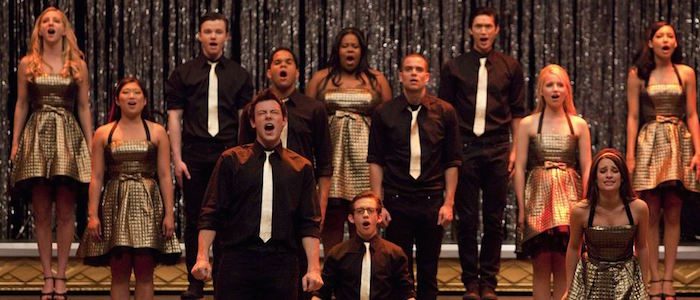
But Mr. Schuester walks in on the auditorium, ready to, as a producer’s cut of the episode implies, leave on a jet plane (there’s a reason why that song was cut from the pilot), only to see his newly together glee club in red and denim, singing a sort of a capella version of Journey’s “Don’t Stop Believin’”. They’re lined up and synchronized in their basic, but warm, moves; electric in how brightly they shine as performers with Rachel and Finn taking the leads. Unofficially a cover of Petra Haden’s acappella version of the song, it was filled with an unerring sense of optimism and it was, for all of its toothy smiles, kind of silly. But that was the beauty of it. Even if the cast and crew thought the nascent version of the show was more escapist and more optimistic than what actually appeared in the pilot, it was nonetheless refreshing and fun and weird. It was not aggressively saying “it’s okay to be a loser because you’re special”, it was more like “it’s okay to be a loser” period. Its pilot, about these people wanting a better shot, seemed to buck up against the idea of being overly special, at first. It was humane, without being patronizing. It’s kind of an adrenaline-filled, overwhelmingly emotional moment to end on. It was kind of perfect.
That Murphy seemed kind of unaware of just how cutting his show was, in addition to its sweetness, (at least publicly) goes to show how bad Murphy is at measuring his own tone in his work (well, we know that all too well now). For better or worse, his desire to create a “postmodern musical” has to be inflected with a little irony. But that inability to balance irony and earnestness would be the unmaking of the show. You can still live on the highs of the clever orchestration, the hokey choreography, but it’s the spirit of the thing that was so winning and so memorable, and so irreplicable. The pilot for Glee did make you believe for a split second that there was a tiny world for outsiders, losers like me.
“Dancing with Myself” — Artie (Billy Idol/Nouvelle Vague) // 1.9 “Wheels” / “Safety Dance” — Artie (Men Without Hats) // 1.19 “Dream On”
Vox’s Todd VanDerWerff isn’t entirely wrong in arguing that Glee started to turn its wheels towards going off the rails in its second episode, “Showmance”, with the introduction of the hysterical pregnancy plot line for Will’s controlling wife Terry (Jessalyn Gilsig). He writes, “That fake pregnancy was an early example of some of the show’s faults, like its propensity to stack up campy, melodramatic storytelling against honest human emotion and its occasionally awful attitudes toward its female characters.” VanDerWerff goes on to argue that with the bait and switch of this plotline, it motioned towards the series’ broader faults about characters’ stakes, or lack thereof.
I’m a little more forgiving of the first eight or so episodes, the total front of season one being 13 solid episodes, which would have been a good, if imperfect season by any measure. There were enough stakes and the time was compressed to suggest this tiny universe of outcasts could be specific and universal without being so universal that it bordered on ultra-pandering. Well, sort of.
Its early moments included clever ways to mock the fear of the arts in public schools, or to exaggerate them. The worry that all roads towards the thirst for fame and performance being quenched resulted in heartbreak and disappointment and catastrophe was embodied by a charmingly excellent guest appearance from Tony Award-winner Kristin Chenoweth as April Rhodes in 1.5 “The Rhodes Not Taken”, a once talented classmate of Will’s in high school and current alcoholic who has lost her way. As she sings “Maybe This Time” from Cabaret, all the hurt and pain from unrealized potential and a squandered future in focus.
That kind of anxiety would be a preoccupation of the show, which is far more interesting a thread than its Issue of the Week tendencies. I believe the moment Glee got bad, terrible mind-numbingly self-serious was during “Dancing with Myself” in “Wheels”, the ninth episode of the first season. Glee had already danced around how seriously it wanted to take itself with Kurt’s coming out, particularly in 1.4 “Preggers”, and while that moment teetered on insufferable earnestness, the episode balanced that out with the absurdity of other plot moments. It’s in “Wheels” that the show begins to bank more on Glee as a cultural moment of making “difference” popular and mainstream and cool, but misreads how to approach empathy. We follow Artie doing wheel dances by himself, follow him at eye level in slow motion through the halls. That episode’s plot revolves around making wheelchairbound Artie an object of disability porn, Will challenging the members of the glee club to spend a week getting around in a wheelchair and then doing a number to “Proud Mary” by Creedence Clearwater Revival (or, really, Tina Turner). It has not aged well and seems misjudged. Its inane body politics isn’t so much offensive as it is baffling, and so one of the core problems of Glee rears its head: how are we supposed to take this supposedly sincere attempt at humanizing a disabled character when the show spends so much time reveling in its ironic bigotry?
The episodes literally turned into lessons, but what are you supposed to do with that when its internal logic only cares about those ideas in the most self-aggrandizing, glib way?
Sue is the de facto greatest offender, a bad guy whose once deliciously acidic takedowns, with florid line readings and all, very quickly began to feel tired and exhausting and basically needlessly cruel. It is not the fact that it is problematique that is Glee’s, well, problem, but that it became an untrustworthy show. The desire to show real emotion, to appeal to marginalized people with storylines of trans identity, poverty, racism, etc. are rendered insincere and glib, the TV show answer to crocodile tears. It made it hard to believe that a storyline so fiercely sentimental could be taken seriously, when, by this time, its other tonal half was aggressively satirical. The two tones cancelled one another out, turning Glee into both incoherent and insincere. It wanted to make fun of the after-school special, and yet epitomize that form at the same time.
But occasionally the show would bounce back in weird ways. In 1.19 “Dream On”, directed by Joss Whedon, a male version of an April Rhodes, Neil Patrick Harris’ Bryan Ryan, would appear to discourage, encourage, and then discourage, and then once again encourage the glee kids from following their dreams. It’s about dreams! One of Artie’s is to be a dancer, and former boyband member McHale dances to a neatly choreographed, but almost unwatchable shot flashmob fantasy in a mall while he’s with his crush Tina. If any other song were chosen, it would be as poorly thought out as “Proud Mary”, but the Men Without Hats ditty “Safety Dance” is kooky enough to get away with a story beat that could resonate as, once again, insincerely sentimental.
Does the show really ever care about Artie? It allows him to be sexual, have a romantic life, to be sure, and occasionally even without the crux of his disability, in season 5. It kind of is interested in how disabled people get around New York. If Artie’s characterization is not the worst, he’s nonetheless emblematic of the show’s paradoxical qualities.
It would be one of the last episodes to try to successfully measure out the two tones, but the fear of failure in the arts would persist throughout the rest of the series’ run. It was better when Glee hadn’t actually backed an idea of whether dreams came true or not, that it could play with disappointment and failure more and broad, abstract ideas and feelings instead of ultimate truths and lesson plans that necessitated didactic dialogue with actual statistics, poorly retrofitted to sound like weaponized dialogue between rivals WIll and Sue. The more Glee tried to mean something real, as opposed to the escapist fantasy it once allegedly intended to be, the more it was on the brink of falling apart.
“Valerie” — Santana (Mark Ronson feat. Amy Winehouse) // 2.9 “Special Education”
Accusations that Glee’s cover songs were sanitized, anesthetized, autotuned monstrosities, or at least dull, isn’t entirely untrue, numbers wise. There are a lot more flat, uninventive songs the show performed than there are truly remarkable ones in their inventiveness or passion. In a sad way, it is to be expected; by the end of season four, the show had performed over 500 songs, so the odds aren’t exactly in its favor. You don’t get a “Somebody to Love” (1.5 “The Rhodes Not Taken), a “Forget You” (2.7 “The Substitute”, feat. Gwyneth Paltrow), or a “La Isla Bonita” (3.12 “The Spanish Teacher”, feat. Ricky Martin) every episode, now do you?
But moving or exciting reinventions or reintroductions to music weren’t so rare; as implied above, they could be part of the show’s pleasures. I’m heavily biased in this choice of highlighting “Valerie”, a song originally written and performed by British pop-rock group The Zutons but made more famous by Amy Winehouse on producer/DJ Mark Ronson’s cover album Version, because that song is my favorite of all-time, and Glee had no small role in solidifying that.
Much of the series felt like it was trying to cram in as many songs as possible, regardless of their relevance to the plot, which is perhaps one of the reasons why the series ran out of steam so quickly. After the first season, it seldom gave the impression that it could enjoy music on its own merits, regardless of how contrived its presence was. But “Valerie” is an exception.
What always struck me as confusing about the series was their need to auto-tune everyone, even the people who could sing. Like her voice or not, Lea Michele can sing, yet she was subject to autotuning throughout the series, as was Jayma Mays, Melissa Benoist (in 2.10 “Glee, Actually”, Marley sings an acapella, unfiltered version of “The First Noël”, and you can just how dramatically they autotune her voice in other songs), Chris Colfer, Darren Criss, and others. Maybe it’s not the autotuning itself that is bad, but how poorly it’s done, how obvious it is. It takes away from the fantasy of Glee and makes it patently obvious of the fakery. It’s frustrating because, even with its Chicago-esque conceit (in that many of the performances take place in the imaginations of different characters), it wasn’t a show that was about artifice and deconstruction, even with the Chicago reference point in mind. It was, on the contrary, focused very much on the ability of these characters to actually perform. If Fame were for dweebs, it would be Glee, but the premise is still the same: talented young people showing off.
Though Naya Rivera’s solos grew after the first season, and her role gradually more interesting, “Valerie” is Rivera, and Santana, at her most fun. It’s an isolated moment that doesn’t seem to matter in the actual context of the show, because the surrounding events aren’t very interesting. But Rivera thrives in this scene, her charisma firing on all ends. It’s ironic that a show that put so much effort into expressing the idea that there was joy to be found in music and the performing arts churned out so few numbers that articulated that same kind of thrill. The beauty of “Valerie”, at least as far as Winehouse’s version goes, is its ability to be, in equal measures, thrillingly alive, melancholic, and filled with yearning. This isn’t sacrificed too much in its translation to the Glee world. On the contrary, if the glee club were to do a version of the song for Sectionals that was closer to one of Winehouse’s reworkings (slower, more savory R&B), it would roll over into annoyingly melodramatic territory like so many of the songs do. “Valerie” is a diamond in the rough in Glee history, a cover of a song that works on its own, perhaps even better out of context.
Continue Reading Revisiting Glee >>
The post I’ve Heard That Song Before: Reflecting on ‘Glee’ as It Turns 10 appeared first on /Film.


from /Film
Read The Rest:slashfilm...